
How to Build Stronger Glutes (and Why It Matters More Than You Think)

How to Build Stronger Glutes (and Why It Matters More Than You Think)
Let's just be honest about what people are searching for. "How to grow my glutes." "Best workout for a bigger butt." "How to get a Pilates body." We see the searches. You're not alone, and there's nothing wrong with wanting to look good in jeans.
But here's the part most fitness content skips: the glutes are the most important muscle group in your body for long-term health, athletic performance, and injury prevention. Building them is one of the highest-leverage things you can do for your body, and it has nothing to do with vanity.
This is the complete guide to building stronger glutes: why it matters beyond aesthetics, the exercises that actually work, and how STRIDE Fitness's Abs & A$$ class is programmed to overload your glutes from every angle in 55 minutes.
Why Strong Glutes Actually Matter
The aesthetic case for glute training is obvious. The physiological case is bigger. Here's why the glutes are arguably the most important muscle group in the human body, especially as you age.
1. They Protect Your Lower Back
Weak glutes force the lower back, hamstrings, and hip flexors to compensate. This is one of the most common causes of chronic low back pain, especially for people who sit at desks all day. Stronger glutes mean less compensation and a back that holds up.
2. They Make You Faster and More Powerful
Every athletic movement that produces force, sprinting, jumping, deadlifting, throwing, originates in the glutes. The glute max is the largest, strongest muscle in the body for a reason. If your glutes are underdeveloped, you're leaving real performance on the table.
3. They Stabilize Your Knees
The gluteus medius (the side glute) is responsible for keeping your knee tracking properly when you walk, run, squat, or jump. Weak glute med is a major contributor to knee pain, IT band issues, and ACL injuries, especially for runners and women.
4. They Reduce Sciatica and Hip Pain
Tight, underused glutes irritate the sciatic nerve and create chronic hip dysfunction. Strengthening and activating them through their full range of motion is one of the most effective ways to address sciatica without surgery.
5. They Future-Proof Your Body
One of the strongest predictors of healthy aging is the ability to get up off the floor without using your hands. That's a glute movement. Strong glutes mean you can climb stairs, get out of chairs, and move freely through your 60s, 70s, and 80s.
6. They Improve Posture
Glutes that fire properly hold your pelvis in neutral position. Glutes that don't pull you into anterior pelvic tilt, the lower-back-arch, belly-pushed-forward look most desk workers develop without realizing it. Want to stand taller without thinking about it? Train your glutes.
7. Yes, They Make You Look Better in Everything
We're not going to pretend this doesn't matter. A strong, developed lower body changes how clothes fit, how you carry yourself, and how confident you feel. That's a real benefit, not a shallow one. The fact that strong glutes happen to look incredible is just a happy coincidence with biology.
The Truth About "Dormant Butt Syndrome"
If you sit for 6+ hours a day (most people do), there's a good chance your glutes are partially "shut off." Sitting compresses the glutes against the chair, lengthens the hip flexors, and trains your nervous system to stop firing the muscle effectively.
The technical term is gluteal amnesia, sometimes called "dead butt syndrome." It's why so many people can't feel their glutes during squats and lunges, even when they're working hard. The muscle isn't gone, the nervous system just stopped recruiting it.
The fix isn't sexier exercises. It's focused, repeated activation through full range of motion under load. That's exactly what a structured glute class is built to deliver.
The Best Exercises for Glute Development
Not all glute exercises are created equal. Some hit the glute max (the big muscle, hip extension, lockout strength). Others hit the glute med and minimus (side muscles, lateral stability). The most effective programs train all three. These are the movements that consistently produce the best results:
- Barbell or Dumbbell Hip Thrust. The single best glute-isolation exercise. Loads the glutes through their primary function (hip extension) at the angle where they generate the most force.
- Romanian Deadlift (RDL). Trains the entire posterior chain, glutes plus hamstrings, through a deep stretch. Builds the kind of strength that protects your back and powers your sprint.
- Bulgarian Split Squat. Brutal unilateral work that exposes side-to-side imbalances and forces each glute to do its job independently.
- Walking Lunges. Combines unilateral loading with movement and balance. Trains the glutes, quads, and stabilizers in a way that translates directly to athletic and everyday function.
- Incline Treadmill Walking or Running. Sustained tension under load. The glutes have to work continuously to drive each step uphill, which builds endurance in the muscle.
- Lateral Band Work and Dirty Dogs. Targets the glute medius for hip stability. Often skipped, almost always undertrained.
Notice anything? These are the exact movements built into STRIDE Fitness's Abs & A$$ class.
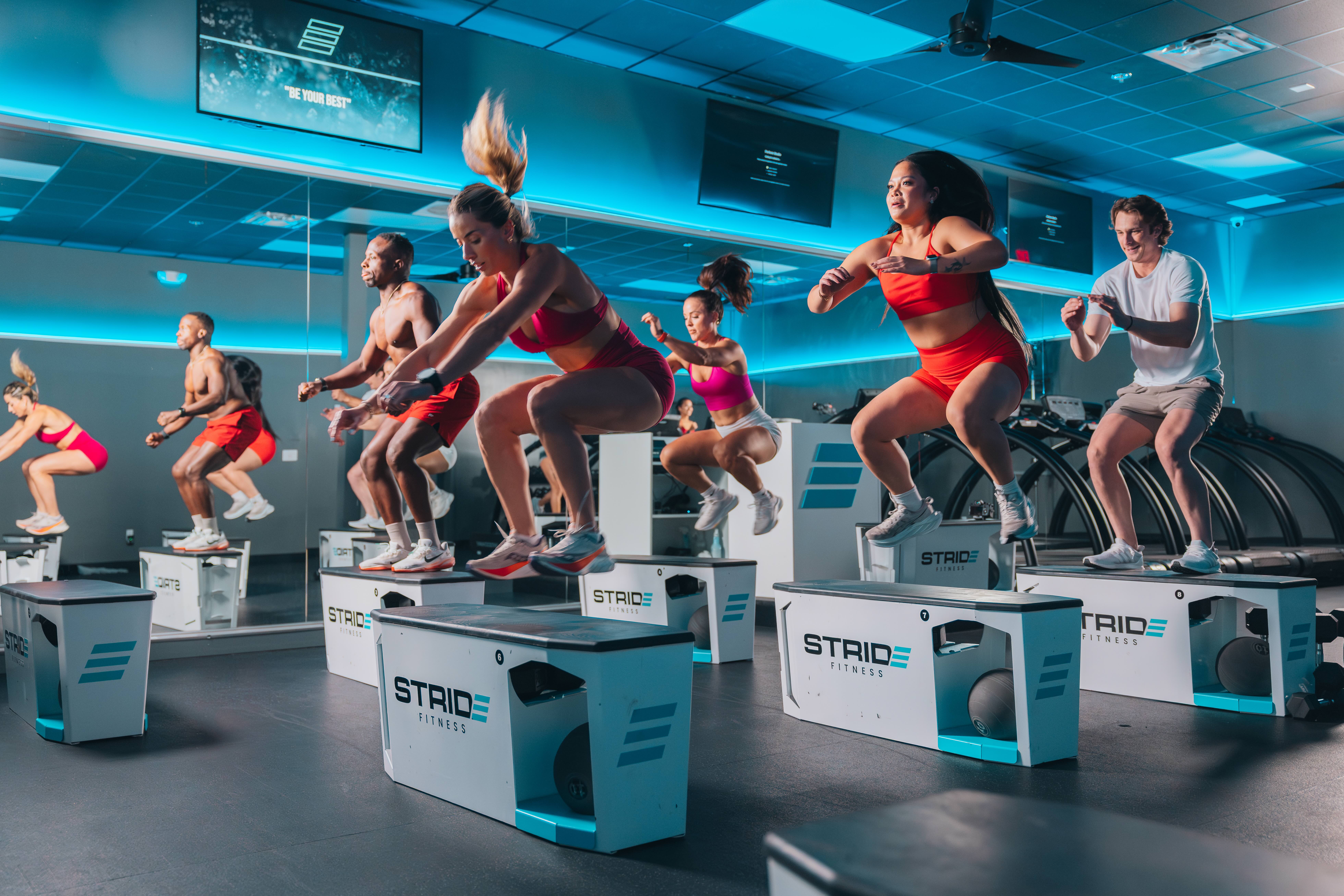
What Happens in STRIDE Fitness's Abs & A$$ Class
Abs & A$$ is our 55-minute lower-body-and-core class, structured to overload the glutes through every modality in a single session. Five progressive sets, each one stacking fatigue on top of the last. Here's exactly how it breaks down:
Hip thrusts and RDLs lay the foundation with big posterior chain loading. Dirty Dogs isolate and fire the glutes from a different angle. This is where we build raw strength before fatigue compromises form.
Single-leg work takes over. Lunges, split squats, lateral shifts. Each rep demands balance, control, and brutal time under tension. This is where imbalances get exposed and corrected, and where each glute has nowhere to hide.
We take the glutes to the tread, loading them with sustained incline efforts. The focus is driving through the glutes and hamstrings to push the hill, not letting the quads take over. Cardio that doubles as glute hypertrophy work.
Core stability and hinge patterns reinforce posture and stamina. Demanding control under fatigue. This is where the work transfers from "isolated glute pump" to "real-world functional strength."
A final isometric hold and pump-out to empty the tank. The goal is to leave the glutes completely smoked and walk out feeling the afterburn with every step.
The Stimulus
Heavy loading + unilateral grind + incline drive + isometric finisher = glutes overloaded in every way possible. One class delivers what most home workouts can't: progressive, layered fatigue across multiple training stimuli, with a coach making sure your form holds up the whole way.
Common Glute Training Myths
Myth: Squats are the best glute exercise.
Squats are great for the quads. They build glutes too, but the deepest part of the squat (where the glutes work hardest) is the hardest position to recover from, so most people accidentally underload the glutes by stopping short. Hip thrusts and RDLs load the glutes more directly through their primary function.
Myth: You can spot-reduce fat off your stomach by doing glute exercises.
You can't. Spot reduction isn't real. But strong glutes do change your overall body composition because they're a huge muscle group that burns calories at rest. Train them seriously and your overall body composition shifts.
Myth: Cardio alone will give you a great butt.
It won't. Steady-state cardio actually breaks down muscle if it's the only thing you do. Glute development requires resistance training. The cardio component (especially incline work) is a complement to strength training, not a replacement.
Myth: Lifting heavy will make me bulky.
This one needs to die. Building noticeable muscle takes years of consistent training and dedicated programming. Most women who lift heavy build a stronger, more shaped lower body, not a bulky one. The "lean and toned" look you're after is just "muscle plus low enough body fat to see it."
How Long Does It Take to See Results?
Realistic timeline if you train glutes 2-3x per week with progressive overload:
- Weeks 1-2: Mind-muscle connection improves. You start actually feeling your glutes during exercises (this is huge).
- Weeks 3-6: Strength gains accelerate. You're lifting heavier, lasting longer, and noticing your glutes work in everyday movement.
- Weeks 8-12: Visible changes start showing up. Clothes fit differently. Posture improves. Your legs and lower body look different.
- Weeks 12-24: Real transformation. Composition shifts, strength compounds, and the glutes become a noticeably developed muscle group.
The non-negotiables: consistency, progressive load, full range of motion, and adequate protein. Skip any of those and the timeline stretches.
Train Glutes the Smart Way
STRIDE Fitness's Abs & A$$ class is built around the exact training principles in this article. Heavy loading, unilateral work, incline drive, and a finisher that leaves nothing in the tank. Coach-led, 55 minutes, every fitness level welcome.
Book Your First Class Free See All Class TypesFrequently Asked Questions
How do I build bigger glutes?
Three things: progressive overload (gradually add weight or reps), train through full range of motion with movements like hip thrusts, RDLs, and split squats, and stay consistent. Most people see noticeable changes in 8-12 weeks of dedicated training 2-3 times per week.
What are the best exercises for glutes?
Hip thrusts, Romanian deadlifts, Bulgarian split squats, walking lunges, and incline treadmill work. STRIDE Fitness's Abs & A$$ class combines all of these.
Why are strong glutes important?
They power athletic performance, protect your lower back and knees, improve posture, reduce sciatica risk, and support healthy aging. They also happen to look incredible, but the functional benefits are the bigger story.
How long does it take to see glute results?
Strength gains in 4-6 weeks. Visible changes in 8-12 weeks of consistent training 2-3 times per week.
Will lifting weights make my glutes too big?
No. Building noticeable muscle takes years. Most women lifting for glute development build a stronger, more shaped lower body without becoming bulky.
Can cardio alone build glutes?
Not really. Incline running and hill work can complement strength training, but glute growth requires progressive resistance. The Abs & A$$ class combines both.
What is the Abs & A$$ class at STRIDE Fitness?
A 55-minute coach-led lower-body and core class structured into five progressive sets: heavy strength, unilateral work, incline drive, core stability, and a glute finisher. Designed to overload the glutes from every angle in a single session.
Is the Abs & A$$ class for beginners?
Yes. Coaches scale movements in real time, weights are self-selected, and treadmill segments are self-paced. First-timers train alongside experienced athletes.
Your First Class Is on Us
The best way to know if Abs & A$$ is right for you is to take a class. First class is free at every studio.
Find Your Studio Explore All Classes